
These setups run from a rolling cart you bolt together in an afternoon to plumbed stone islands that need a contractor and a concrete slab.
A hose-fed camp sink on casters keeps the whole station movable if you need to roll it away; once you own the ground beneath the grill, you can build in the kamado and the bar overhang both.
1. Black Metal Griddle Setup

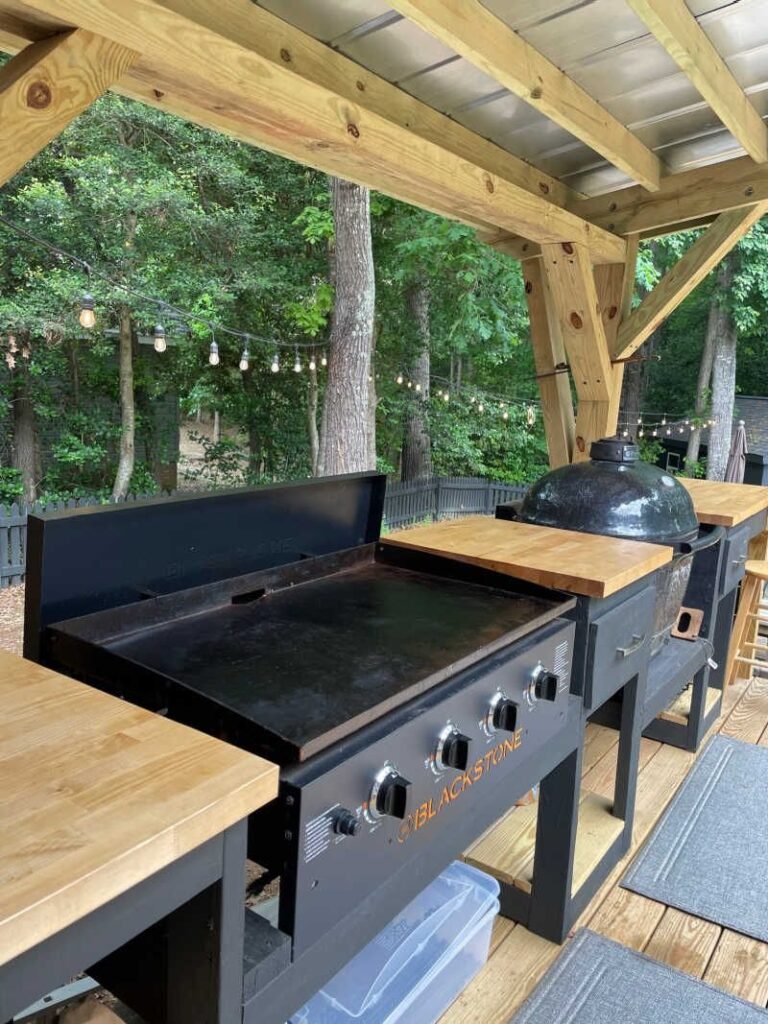
Black metal griddle setups work best when the griddle sits flush with its counters, not perched on top like an afterthought.
The dark frame against light wood butcher block gives you that built-in look without custom welding; standard cabinet frames in charcoal or gunmetal gray hide the body while the cooking surface stays accessible.
I have seen this done with stock outdoor cabinets and a cutout measured to the griddle lip.
If you already own the Blackstone, budget for the frame and counters only; if you are buying new, the standard model fits most prefab openings without modification.
A ceramic cooker on the side works when you have the patio depth; the griddle itself needs no overhead protection to run.

Versatile Grill Station: This outdoor prep cart includes 2 detachable boards to accommodate various cooking setups. You can take out the upper board for compact charcoal cookers, detach the center one for propane cylinders and tabletop gas cookers, or leave them installed for additional preparation area

Fits Mainstream Bags Securely: Measuring 25×17 cm, this trash bag holder is designed to securely fit 13 gallon trash bags as well as most standard-sized and grocery bags. Its stable build ensures it won’t wobble, making it a reliable outdoor trash can for any setting

Modular Outdoor Kitchen Island System: As part of the Feasto KT2435 Series, this outdoor kitchen unit seamlessly pairs with matching sink, storage, and prep station modules. Mix and match components to build a fully customized outdoor kitchen for your patio or backyard, and expand your cooking setup over time without replacing the entire unit
2. Light Wood Cabinetry
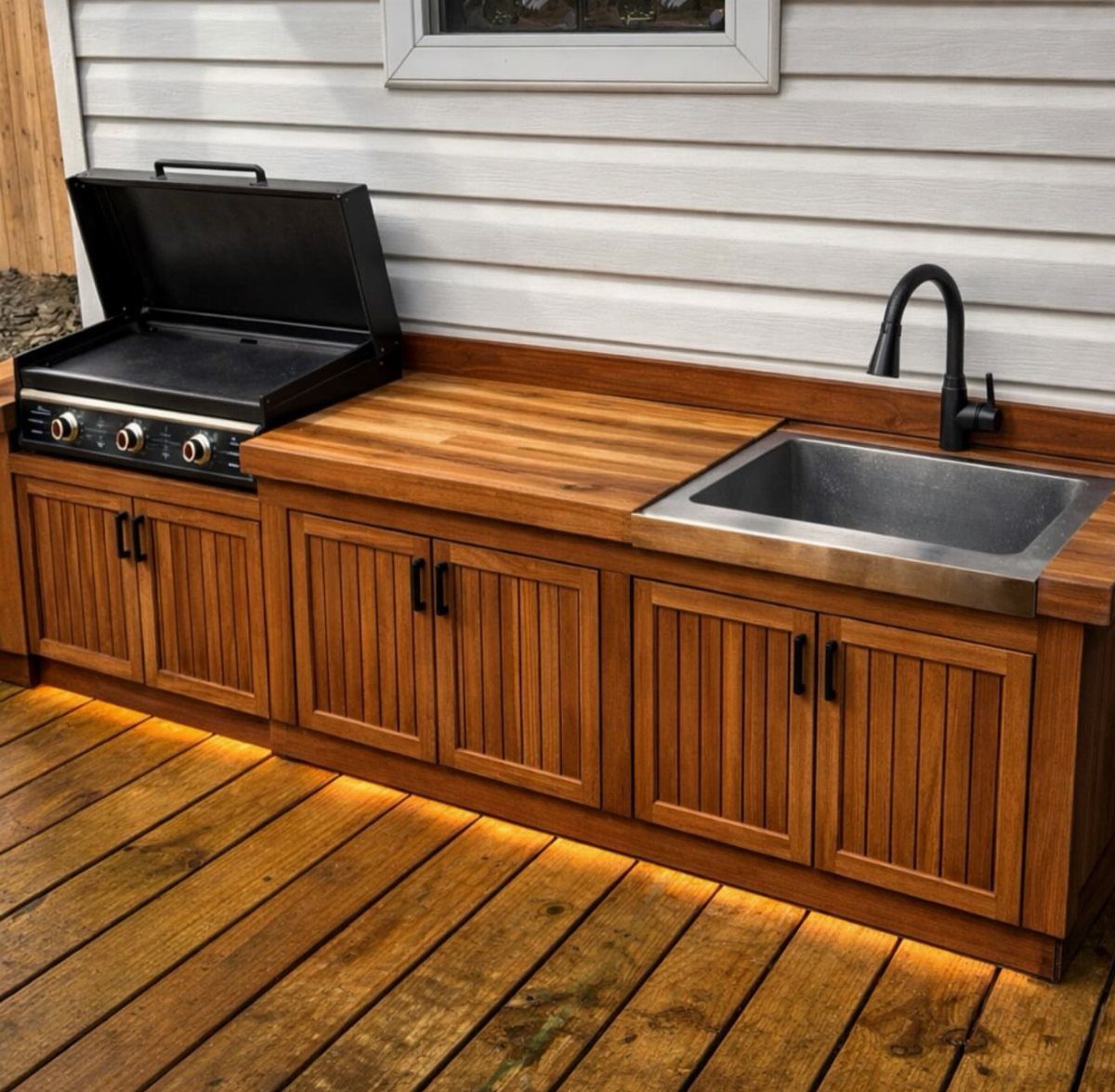
Vertical slats on light wood cabinets let air move through stored propane gear and charcoal bags without calling attention to the ventilation.
The grey stone block counters shown are harder to source than butcher block but take a hot pan straight off the griddle without a trivet; if you are building from scratch, weigh that against the weight, stone this thick needs a reinforced base.
The black faucet and black griddle against pale wood read modern without going industrial.
I would check that your wood is rated for exterior use or plan to restain every two seasons; the slat detail looks custom but ships as standard paneling from several outdoor kitchen suppliers now.
Toe-kick lighting is optional, though it turns functional storage into something you actually want to look at after dark.

ENHANCES THE LOOK OF YOUR YARD - This product is used to hide your 20Lb propane tank. It is the perfect solution for those of us who won’t see the unattractive metal tank in our patio. This propane tank hideaway is the perfect way to enhance the look of your patio.

Quality Cylinder Storage Cabinet: Our 2-tier horizontal cylinder storage cabinet measures 788x763x889 mm/31.02x30.04x35 in. It boasts strong load-bearing capacity and is easy to install with complete accessories. Suitable for storage warehouses or factory workshops. Secure packaging ensures product integrity during delivery.

【SECURE, RESTRICTED-ACCESS CYLINDER CAGE】 Built-in padlock hasp lets you lock down your propane cylinders and restrict access to authorized personnel only (padlock not included). As a lockable gas cylinder safety cage, it protects valuable LPG tanks from theft and tampering — ideal for job sites and warehouses where hazardous materials need controlled access.
3. Stone Countertop Bar

Stone countertop bars solve the problem every outdoor cook faces: where do people stand without blocking the grill? The granite overhang here gives you that buffer, and the black metal stools tuck under when no one is eating.
Gabled roofs shed rain better than flat covers, which matters if you are leaving the stone exposed; sealed granite handles weather, but the grout between stones needs annual touch-up.
The integrated mini fridge and sink mean fewer trips indoors during a cook, though running water lines to a patio bar adds cost most weekend budgets do not cover.
If plumbing is out, skip the sink and size the fridge for drinks only; the bar still functions as a serving ledge and social anchor.
Black lattice stools match the griddle without matching it exactly, a small choice that keeps the space from looking like a showroom set.

HIDDEN SUPPORT – This hidden granite countertop flat bracket is the ideal heavy-duty support for countertop overhangs on pony walls and raised bar countertops. The narrow profile makes it look nearly invisible for a clean look.

OUTDOOR KITCHEN: Modular attachment for versatile configuration within your Medallion Series Modular Outdoor Kitchen

Home Bar Mat That Gets Used - The bold white Cheers script turns any counter, kitchen counter or wet bar into a proper home bar setting. It earns a comment from every guest who walks past and a quiet smile from you each time you pour.
4. Built-in Ceramic Kamado Cooker
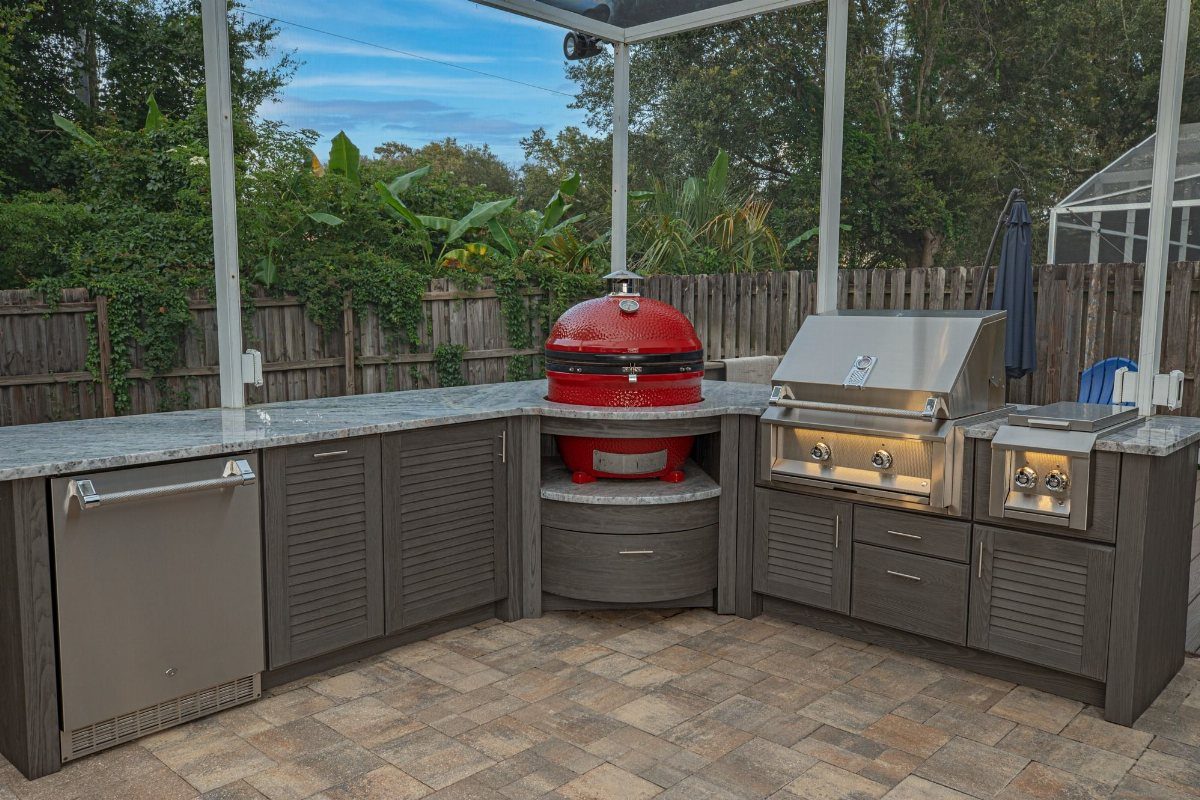
A ceramic kamado cooker next to your griddle gives you two heat zones without two gas lines; the kamado runs on charcoal and holds low-and-slow temperatures the flat top cannot touch.
Built into the corner, it sits at counter height for loading and unloading, not ground level where you are bending over hot coals.
The natural wood frame surrounding both units needs more clearance from the kamado than from the gas grill; check the manufacturer specs for combustible surfaces, or line the inside of that corner cabinet with cement board.
If you are choosing between this and a second gas burner, the kamado wins for anyone who smokes brisket or bakes pizza more than twice a summer. It is slower to fire and slower to cool, which is the trade.
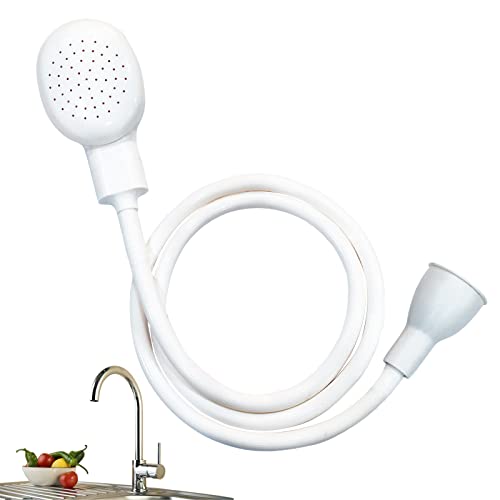
【Pay Attention to Faucet Size】Only suitable for for round faucet with a diameter of 0.59"-1.26". The faucet sprayer attachment is suitable for round faucet, but not suitable for square faucets/old fashioned faucets / bathtub faucets. Faucet sprayer opening is 1.2 inches, the hose is 50.39inch. Be sure to measure your faucet's diameter and faucet shape to assure correct size before purchasing.

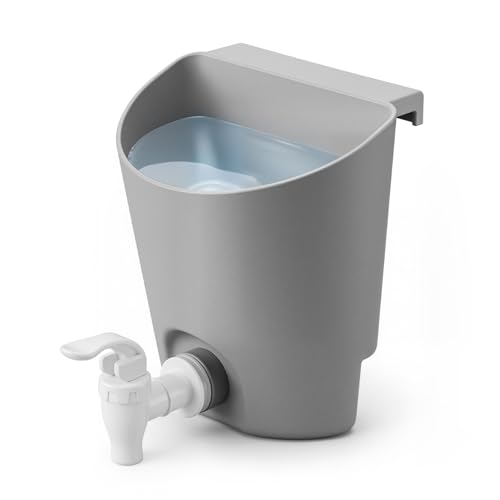
PLAY SINK WITH RUNNING WATER, NO BATTERIES - Gravity-fed design means water flows the moment your child presses the tap. No batteries, no electricity, no plumbing. Just fill the tank, clip it on, and let the play begin.
5. Outdoor Kitchen Island

Modular outdoor kitchen islands ship as finished boxes you bolt together, not projects you build from studs. Black handles on grey read sharper than all-stainless, and they hide fingerprints.
The mini fridge slot is built in, not an add-on, so measure your beverage supply against the cubic feet before you buy.
U-shaped layouts like the Edgemont line give you prep, cook, and serve zones in one island, but they need generous patio depth to avoid feeling like a galley kitchen.
For smaller decks, a straight island with the griddle centered and fridge at one end does the same work in half the footprint. Powder-coated steel frames outlast wood in humid climates; in dry zones, either lasts fine.

Built-In Cold Drink Fridge: This ROVSUN grill cart features a dedicated refrigerated area to keep beverages perfectly chilled while you cook. No more running inside for cold drinks or filling coolers with melting ice. Store beer, soda, or water right at your prep station—ideal for hot summer barbecues, garden parties, or all-day tailgating events

Dedicated Propane Tank Area: This ROVSUN grill cart features a separate propane tank storage compartment designed to keep fuel safely out of sight. No more unsightly tanks cluttering your patio or creating tripping hazards. The dedicated space makes refills quick and easy while maintaining a clean, organized outdoor cooking environment.
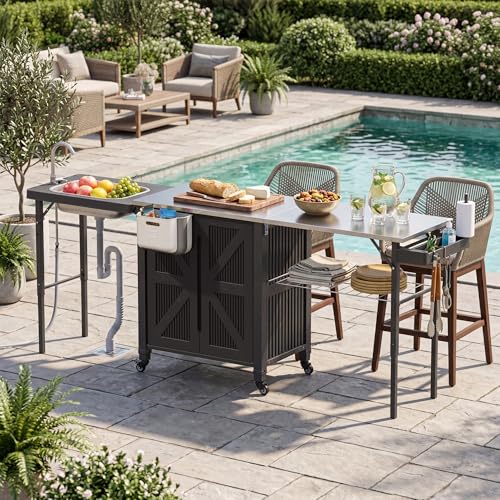
【3-in-1 Outdoor Grill Station with Sink】This innovative outdoor grill cart combines an outdoor cooking station, outdoor kitchen island, and outdoor storage table in one. Features a foldable sink with a built-in faucet, making it easy to wash food, fruits, and utensils while cooking outdoors. Perfect for upgrading your outdoor cooking station
6. DIY Blackstone Griddle Station

A rolling griddle station on casters lets you chase shade, move under cover when rain starts, or roll into the garage for winter.
The stained wood frame here is built around the Blackstone dimensions, not adapted from an existing cart; that means a lower shelf sized for the propane tank and side counters at a comfortable flipping height.
Dark stain hides the grease that accumulates on any surface near a flat top.
If you are building this yourself, use exterior-grade plywood for the box and hardwood for the visible faces; construction lumber warps within a season.
The open lower shelf is easier to build than a cabinet and faster to clean, though it leaves the tank exposed.
Add a hinged lid over the griddle when it is cool to turn the whole station into a serving counter between cooks.
Two locking casters and two free ones give you stability when you are standing at it and mobility when you are done.

【Insulated Freshness-Locking Lid】The griddle comes with a full-coverage lid and an enameled iron plate design, ensuring even heat distribution, rapid heating, and long-lasting heat retention. It can lock in the moisture and nutrients of ingredients, and make cooking more delicious

Stainless Steel Tabletop: This Outdoor Grill Table features a rust-resistant, stain-resistant stainless steel top that’s easy to clean. Perfect for food prep, it provides a durable and low-maintenance workspace for grilling and cooking outdoors

Exceptional Multi-Functionality: This outdoor kitchen island functions as a grill cart, outdoor table with storage, outdoor bar, serving cart, food prep station, or pizza oven stand. Its sturdy construction makes it suitable for the patio, backyard, garage, or even indoor kitchen use
7. Integrated Beverage Cooler
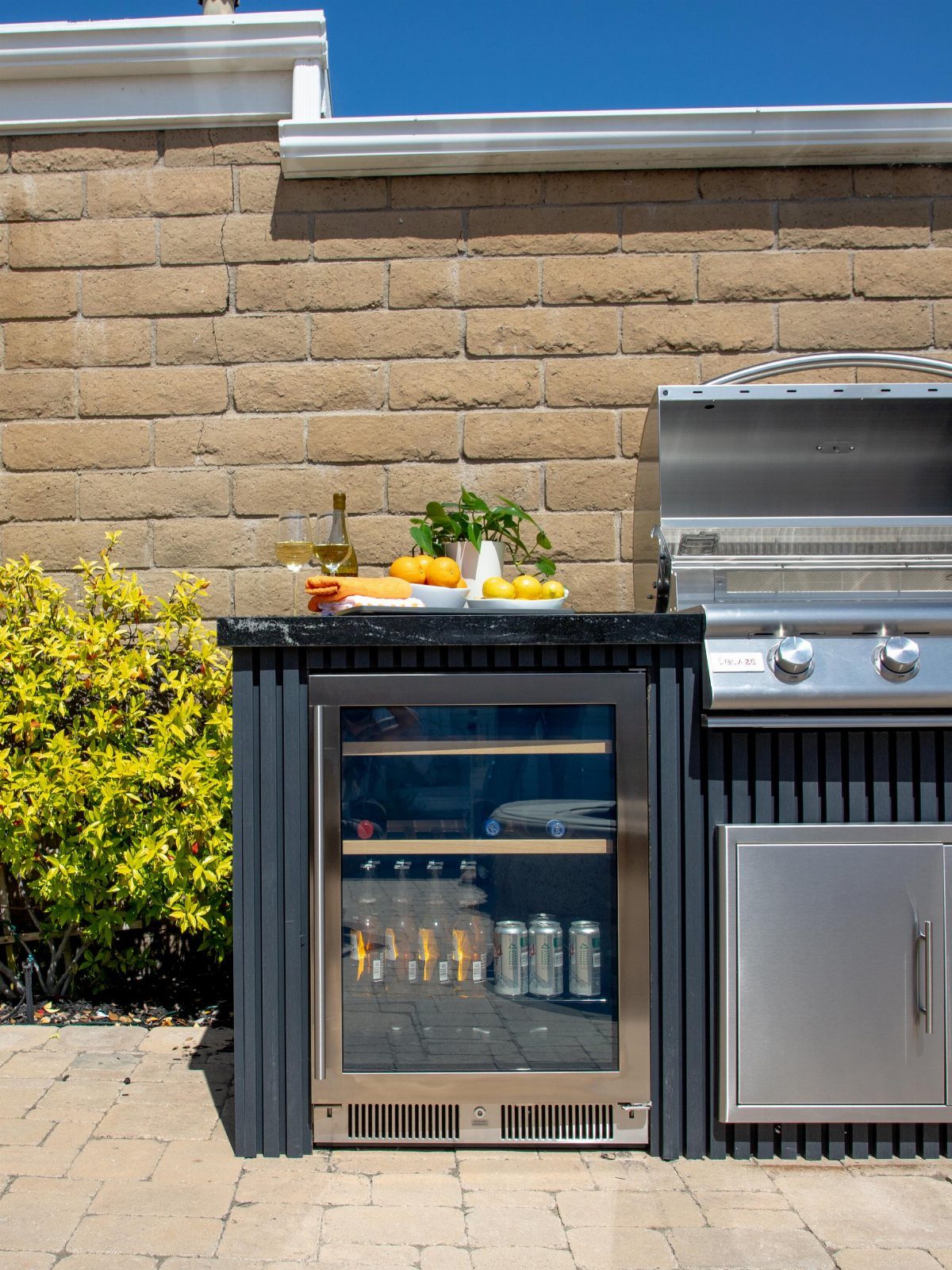
A built-in cooler keeps drinks cold without the back-and-forth to the house. A glass-front refrigerator looks sharp, but two plastic rectangular coolers set into a dark stained wooden base skip the wiring and keep more money in your pocket.
SoCal Custom Rustics built theirs as a buffet-style bar table with side-by-side white coolers. The trade is ice runs versus electricity; the win is placement anywhere in the yard.
For a permanent kitchen, Kris’ Faux Stone setup tucked a cooler into stacked stone with stainless doors nearby, which keeps the whole wall looking finished.
Skip this if your grill sits close enough to the indoor fridge that grabbing a can is barely an interruption. Add it when you host groups and the kitchen becomes the hangout spot itself.

ENHANCES THE LOOK OF YOUR YARD - This product is used to hide your 20Lb propane tank. It is the perfect solution for those of us who won’t see the unattractive metal tank in our patio. This propane tank hideaway is the perfect way to enhance the look of your patio.

1-1/2” x 1/8” angle iron frame. Solid 14-gauge steel top and bottom

Unique Design-- Heavy duty door frame design and 304 stainless steel brushed panels create our exquisite and durable access door. All seamless design and no sharp corners to safeguard safety.
8. Open Shelving Design

Open shelves under the counter trade hidden storage for grab-and-go speed. Bamboo slats keep plates and tools right where the cook stands; no cabinet door to open with greasy hands.
Hartwells’ light wood frame flanks the grill with two open units, while Craig’s three-level design stacks serving space above storage below. Both use unfinished lumber, which greys naturally or takes a single coat of exterior sealant in an afternoon.
Cost stays low because there are no hinges, no pulls, no adjusted doors to hang straight.
Rain and sun will hit everything out here, so plan what you store and check the forecast before you load up the shelves.
Shelves in full sun need a roof or a cover; otherwise everything on them fades or warps by season two. I would build this for a covered patio or add a canvas curtain on a tension rod underneath.

HIDDEN SUPPORT – This hidden granite countertop flat bracket is the ideal heavy-duty support for countertop overhangs on pony walls and raised bar countertops. The narrow profile makes it look nearly invisible for a clean look.

[Compatibility] This countertop support bracket is compatible with all types of countertops, including those made of marble, granite, quartz, and manufactured stone. Providing reliable and secure support for your countertop, the hidden island flat wall support bracket has a weight loading capacity of 80 lbs per piece
HIDDEN SUPPORT – This hidden granite countertop flat bracket is the ideal heavy-duty support for countertop overhangs on pony walls and raised bar countertops. The narrow profile makes it look nearly invisible for a clean look.
9. Outdoor Kitchen with Sink

A sink turns the grill station into a real outdoor kitchen. A stone island that pairs the Blackstone griddle with a stainless sink and faucet means washing hands, rinsing tools, and filling pots without stepping inside.
Sintered stone countertops around a built-in grill give you a solid work surface that handles heat and spills; dark wood slatted cabinets below with a wall-mounted utensil organizer overhead keep the tools in arm’s reach.
Both need plumbing, which is the line between weekend project and hired help. If your patio sits on a concrete slab, running drain and supply lines may cost more than the cabinet itself.
For renters or budgets under five hundred, a hose-fed camp sink on a rolling cart is the stand-in. Build the permanent version when you own the wall behind it and the ground beneath.

Widely Used: Amcortn (50 FT) faucet sink hose attachments are great for gardening, RVing, dog cleaning, dog pool filling, car cleaning, and house cleaning

PAY ATTENTION TO FAUCET SIZE: In order to avoid returning due to product size problems, please make sure that the interface size of this product is suitable for your faucet before purchasing!! Our faucet sprayer attachment can suitable for most round faucet type with a diameter of 0.59"-1.26", not suitable for square faucets, old fashioned faucets and bathtub faucets.

Widely Used: Amcortn (50 FT) faucet sink hose attachments are great for gardening, RVing, dog cleaning, dog pool filling, car cleaning, and house cleaning
DIY Outdoor Kitchen Tips
A weekend build lives or dies by the cut list you make Friday night.
Measure the griddle lip, the propane hose length, and the swing of any cabinet door before you buy a single board; Saturday morning is too late to find your Blackstone sits proud of the counter because the frame spec was wrong.
Exterior-grade plywood runs more than construction lumber but saves you a rebuild next spring.
For the propane hookup, a two-stage regulator and a quick-disconnect fitting are the safe pair; the hardware store sells both in the grill aisle, not the plumbing section.
Weatherproofing means sealed edges and a cover that sheds water off the griddle, not just a tarp draped over the top.

Heavy Duty Construction: No plastic or wood! The extra large kitchen island consists of heavy gauge steel legs, shelves and bases, which ensures long-lasting use for years.

High-quality 304 stainless steel: The outdoor grill table with sink is made of 304 stainless steel, supported by a sturdy, heavy metal frame and complemented by a stainless steel countertop, ensuring unparalleled durability and lifespan. The stainless steel tabletop is easy to clean and maintain

OUTDOOR DINING CART COVER DIMENSIONS: 41"L×24"W×32"H. Patio prep table cover designed for Royal Gourmet double-shelf movable dining cart table PC3401B&PC3401S; Also compatible with similar size outdoor furniture, patio table, outdoor cooler cart, storage bench, outdoor bar, etc.
Trends for Outdoor Kitchens
Integrated appliances now mean the griddle sits in a cutout, not on a cart beside the patio door. Natural materials have shifted from the stone-everywhere look of recent years toward lighter wood frames with stone used where heat actually hits.
Multifunctional space is the bigger change: the same counter flips from prep to serve to bar, and the grill station doubles as the hangout spot because the cook no longer faces the wall alone.
String lighting over the work area is part of this, not decoration for its own sake; it extends the usable hours without the cost of wired fixtures.
Cooking on a Blackstone
Eggs and fried rice are the griddle’s strength, not the place to test whether your seasoning layer is thick enough.
Thin proteins like fish need more oil than you think, applied to the food and the surface both; the flat top rewards patience, not the first sizzle.
After the cook, scrape while warm, wipe with a thin layer of oil, and call it done.
The grease trap under the left side fills faster than the manual suggests; check it every third use or it overflows onto the patio stone.
A metal bin mounted to the frame keeps the oil bottle and the scraper where you actually need them, not back in the cabinet.
Building a Blackstone Into an Outdoor Kitchen
Ventilation for a built-in griddle is about heat rolling forward, not smoke rising. Leave open counter behind the griddle surface so the radiant heat has somewhere to go; a tight backsplash traps it against the wall and cooks the paint.
Prep space means room for a cutting board and a sheet pan side by side, not a ledge that barely fits a spice shaker.
If your design puts the griddle under cover, the roof needs to be high enough that the grease vapor cools before it hits; low ceilings turn into cleaning projects by August.
Frequently Asked Questions
Can you put a Blackstone griddle in an outdoor kitchen?
Setting the griddle into the counter rather than leaving it on top keeps grease splatter lower and the whole station looking built-in.
Charcoal or gunmetal frames swallow the bulky base so only the flat-top shows, and the common 28-inch and 36-inch models drop into most prefab cabinets without a saw.
A kamado or pellet smoker off to the side is worth the space if your patio is deep enough; the griddle runs fine under open sky.
What are the trends for outdoor kitchens in 2026?
Integrated appliances and multifunctional spaces are where the money is going.