

A backyard hobby shed is a detached, single-purpose workspace that lives between your house and your garden, sized for one person and one project at a time.
The right one depends on whether you need four seasons of use or fair-weather weekends, because a $3,943 kit with no roof or foundation and a $15,000 insulated pod with factory wiring both qualify, but only one keeps paint flowing in January.
The VESTAEL Modular Pod‘s 118 square feet of pre-wired, insulated space costs roughly triple the ShedMaster Meadowview, yet after you buy shingles, pour a slab, and run your own electrical, the gap shrinks faster than most buyers expect.
1. Astoria

The Astoria is a $8,595 kit that ships free to the lower 48, giving you 117 square feet inside a 13′ × 11′ footprint.
What sets it apart is the full-glass front: one wall made entirely of an extra-tall door and window, treated as a single plane of light.
The build takes about two days, same as the California at $300 more, but you trade the California’s four configurable windows and French door for this single dramatic statement.
That wall of glass changes how the shed lives in your yard. Morning light floods the interior from one direction, which is ideal if you paint, draw, or do anything color-sensitive.
But the visibility cuts both ways. Anyone walking past sees your contents, your mess, your half-finished project.
The maker pitches this for offices and she-sheds, and that framing matters. A desk facing the glass feels connected to the garden; a workbench with tools and hardware laid out feels like a display case.
I would want to know exactly what I planned to do in there before committing to the exposure. No overhang or awning is mentioned, so the glass takes weather head-on unless you add something yourself.
At 117 square feet, the interior is identical to the California and Bristhol.
You are not paying for more room. You are paying for the modern profile and the light, which is a fair trade if the sightlines work for your yard.

【Clear Window Design】This 8×6 storage shed is designed with built-in clear windows to welcome natural daylight and improve visibility when reaching for items.


VERSATILE STORAGE OPTIONS: With external dimensions measuring 55.3 inches in length, 31.8 inches in width, and 74.4 inches in height, DWVO's garden tool storage comes in a multitude of sizes, colors, and shapes to choose from; Great for outdoor backyards, gardens, courtyards, and utility rooms; Additionally, DWVO's outdoor storage can serve as a cozy and secure shelter for pets
2. California

The California kit measures 13′ × 11′ with 117 square feet inside, priced at $8,895.00. Four windows ship with the kit but arrive uninstalled, so their placement is decided during assembly.
Light changes dramatically depending on where those windows land.
Two of the four actually open, which matters more than it sounds; a cross-breeze through opposing walls cools the space faster than any single vent, and in a 117-square-foot box that air turnover keeps glue fumes or paint odor from lingering.
The flat roof means no dormer windows or overhead light, so wall placement becomes the only daylight strategy.
Wall usability slides in the other direction. A window centered on a 13-foot span splits that wall into two short sections, neither wide enough for a full sheet of pegboard or a eight-foot lumber rack.
Shift both windows to the same wall and the opposite wall opens up for vertical storage, though that wall loses any natural light.
During my own builds, I’ve learned that "configurable" here means cutting rough openings with a jigsaw after the wall panel is already stood, then weather-sealing with the provided trim; it is not plug-and-play.
Mismeasure by half an inch and the window frame floats in the opening, so a helper and a level are non-negotiable.
The French door at 52 inches wide handles bulky equipment better than a standard single door, though it eats the same wall the windows might want.
I would choose tool storage over symmetry and group the windows on the gable ends, leaving the long walls free for benches.

Spacious Interior for Easy Organization: Measuring 12x20.2 FT, this oversized shed provides ample room for tools, garden gear, and seasonal items. Use it as a spacious storage hub or transform it into your private backyard workshop


118 SQ FT BACKYARD OFFICE POD — Create a dedicated 10 x 13 ft outdoor workspace with approximately 118 sq. ft. of enclosed space for remote work, meetings, studying, hobbies, creative projects or exercise.
3. Solana

A 13′ × 10′ floorplan with only 80 square feet inside tells you exactly what the covered porch costs you: the porch steals twenty square feet of interior space to give you a forty-square-foot outdoor room.
That trade either works for your hobby or it doesn’t.
For my money, the Solana makes sense when your actual work stays compact and your downtime matters. A potting bench, a small jewelry station, a writing desk that folds up: these fit in 80 square feet.
The porch becomes where you step outside to review a glaze batch in daylight or shake off solder fumes without losing your spot in the project.
At $6,795.00 with shipping included, it’s the cheapest way to get two rooms out of one kit.
The roofline sits lower than the straight-wall models in the same lineup, and that matters after a wet weekend. Snow stacks where the porch meets the main wall if you’re not religious about brushing the joint clean.
The covered area itself stays usable in light rain, but hard wind pushes water at an angle the shallow overhang won’t catch. Think of the porch as fair-weather space with insurance, not a year-round second room.

【Spacious Storage】This outdoor metal shed offers ample storage for tools,lawn mowers,bicycles,BBQ grills,and more.Its large capacity keeps your yard tidy and meets diverse needs,even doubling as a pet shelter or greenhouse.Stay organized effortlessly.

【Spacious Storage】This outdoor metal shed offers ample storage for tools,lawn mowers,bicycles,BBQ grills,and more.Its large capacity keeps your yard tidy and meets diverse needs,even doubling as a pet shelter or greenhouse.Stay organized effortlessly.
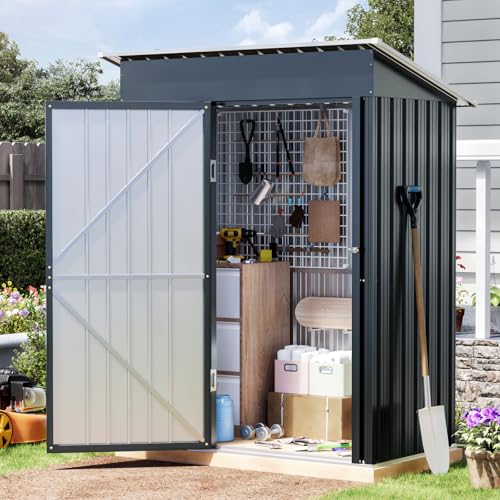
Compact 3x5 FT Design – Ideal for small outdoor spaces such as patios, balconies, and narrow side yards. Great for organizing tools and supplies.
4. Moderna
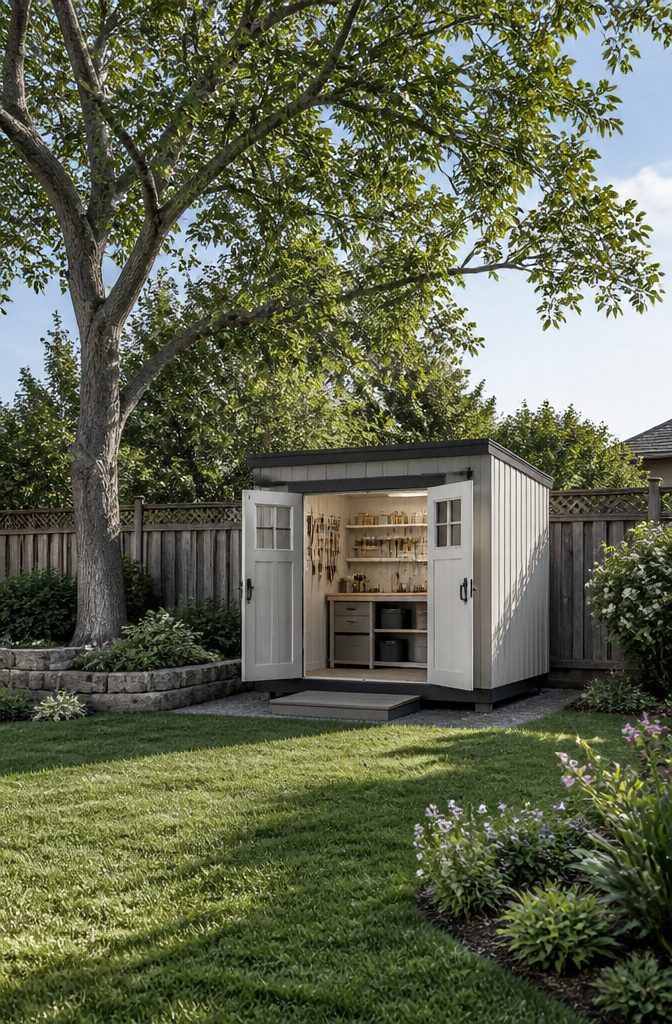
The $5,995.00 price tag on the Moderna’s 10′ × 10′ footprint puts real limits on what happens inside. Those hundred square feet of interior space shrink fast once you account for work surfaces, storage, and the door swing.
Two walls with tools or lumber and the center aisle narrows to shoulder width, which is manageable for a potting bench or a compact desk but turns on you the moment a second person walks in or a project spreads sideways.
Painting, sewing, or electronics work fine here because the activity stays vertical or fits on a single table. Woodworking with full sheet goods, small-engine repair, or any hobby needing floor space for staging parts runs into the walls quickly.
Foundation work changes with the smaller box. A gravel pad or a few concrete piers handle the lighter load without the full perimeter slab larger sheds demand, so leveling the site yourself on a Saturday morning is actually realistic.
You pay for that lightness with less forgiveness: frost heave or settling hits harder when the frame has no mass to absorb it, and doors start sticking faster than they would on a heavier building.
What this size rewards is discipline.
You bring in what you use, you store the rest elsewhere, and the space stays usable. Let anything accumulate and the hobby shed becomes a storage shed with a chair in it.
Add 118 square feet of living space to your property with this modular pod, perfect for your home gym, backyard office, art studio, or guest room.
That frame, pulled from a slightly larger competing pod, shows what the Moderna is up against: one hundred usable square feet sits right at the edge of what most people consider a room rather than a cabinet.
Choose this size only if you already know exactly what fits.

【Compatible With】: Compatible With Arrow ShelterLogic Shed storage sheds and shelters

1. Heavy Duty Hardware: This wood shed kit comes with T-Hinges and Heavy Duty Barrel Bolts and T-Handle Locks to ensure your shed stays secure and stable.

Compatible with: Our storage sheds parts is designed for metal shed sliding doors, storage sheds parts Kit for Arrow Shed replacing the original damaged parts
5. Bristhol
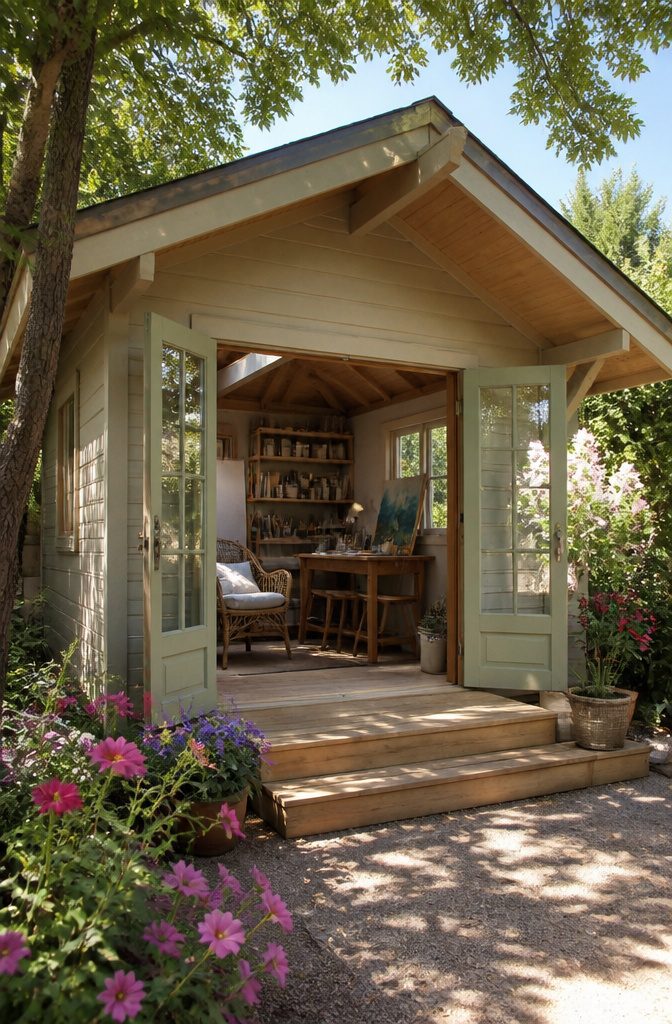
The Bristhol sits at $7,995.00, two hundred dollars under the California and six hundred under the Astoria, though all three share the same 13′ × 11′ footprint and 117 square feet inside.
Where the Bristhol diverts is that deep front overhang, a signature that reads entirely different from the Solana’s approach.
The Solana bolts a 40 square foot covered porch onto a smaller 13′ × 10′ box; the Bristhol folds its shelter into the main roofline, extending the gable forward without building full walls.
That choice matters for how you use it.
The Solana porch is a separate room, technically outdoors, good for muddy boots or a smoker. The Bristhol overhang is more awning than annex, deep enough to catch rain off those tall glazed double doors but open on three sides.
You gain shade and some dry entry space without losing the light or the breeze, which for a studio or a reading corner probably wins.
For a bedroom conversion, the Solana’s enclosed porch gives you a buffer against weather and bugs; the Bristhol leaves you closer to whatever’s outside.
The proportions change too.
A gable roof already pulls the eye upward, and pushing that triangle forward over the doors elongates the front face. From the yard the building reads taller than its width, even at 13′ across.
Inside you still get the same square footage as the Astoria, same two-day build estimate, same free shipping to the lower 48. The finish, the foundation, and the roofing layer stay your problem, same as every model in the lineup.


Custom Runner Design : Solid Color | Color : Burnt Orange

OEKOTEX Certified and No Shedding Medium Pile( 0.50 inch - 0.60 inch ) Runner Rug. Proudly Custom Size By Feet in USA Facility
6. Myrtle

The Myrtle lands right at $6,595.00 for a 10′ × 10′ footprint, same eighty square feet as the Solana but two hundred dollars less and with French doors instead of a porch.
Those doors are what sell it or sink it, depending on your yard.
French doors on a box this small eat wall space when they swing. Both leaves need clearance inside, so you lose a few feet of interior depth along that whole wall.
In a ten-by-ten, that matters. The upside is the light and the width: two open door panels give you a six-foot aperture for moving a table saw or a potting bench straight through, no angling.
The Astoria’s fixed glass front and extra-tall single doors look generous but can’t match that opening width.
Whether the pair seals as well as a single door depends on the sweep and your slab. Two doors, twice the bottom gap to manage, twice the weatherstrip to compress.
Most buyers add a door sweep after the first season. There is a real cost to that feature: the Myrtle gives you working light and a generous passage, but only if you have the interior floor space to surrender.

Spacious 10x8 FT Storage Capacity – Provides ample space for storing bikes, lawn tools, garden supplies, and seasonal equipment. Perfect for backyard, patio, or garden use.


Ample Storage Capacity: DWVO 10'x8' outdoor storage shed measures 122.4''L x 94.09''W x 75.98''H, and provides a capacity of 500 Cuft; It offers a secure and weather-resistant shelter for garden tools, lawn equipment, bicycles, and outdoor supplies; Can also serve as a pet haven or a plant greenhouse
7. Whales
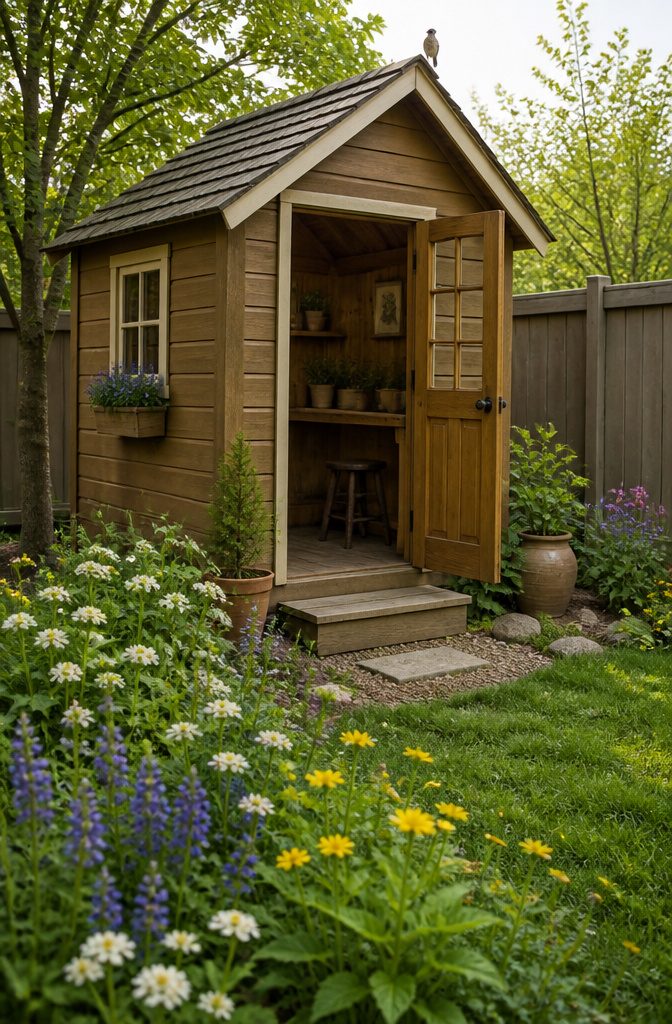
A 10′ × 10′ footprint at $6,395.00 is the cheapest way into the cottage look. You get the same spruce siding, same finished interior, and same doors as the pricier models, just without the extra floor space.
The 80 sq ft works if your hobby fits in a corner. A potting bench and a chair, yes.
A full workshop with lumber storage, no. That covered porch on the Solana starts looking tempting once you price adding your own roof extension later.
Up close, the cottage details hold about as well as you’d expect from a kit at this price point.
The trim is real wood, not vinyl print, but the corners are simple butt joints rather than mitered returns. Most buyers won’t notice from five feet away, and paint covers a lot.
The Myrtle sits at the same 10′ × 10′ size but costs $200 more.
That gap buys you, as far as I can tell, a name that sounds less like a building code and a few stock photos with staged interiors. Functionally the Whales matches it door for door, board for board.
If the cottage aesthetic is what you’re after and your weekends are already spoken for by the build itself, the cheaper kit leaves that $200 for the paint and the first shelf you’ll realize you needed.

【Built for Outdoor Durability】Made from reinforced galvanized steel panels,this outdoor storage shed is designed to resist rust,dents and surface wear.A dependable storage solution for year-round use in rain,sun,wind and snow
Multiple Uses: The Patiowell compact storage room is versatile, fitting perfectly in your backyard, garden, or anywhere you need. It can be utilized as a storage room or tool room, to keep your yard tidy
[Metal Storage Shed]: Enjoy an interior space designed to accommodate your storage needs. Its metal tool shed offers more interior space than other tool sheds on the market, enabling versatile usage.
8. ShedMaster Meadowview
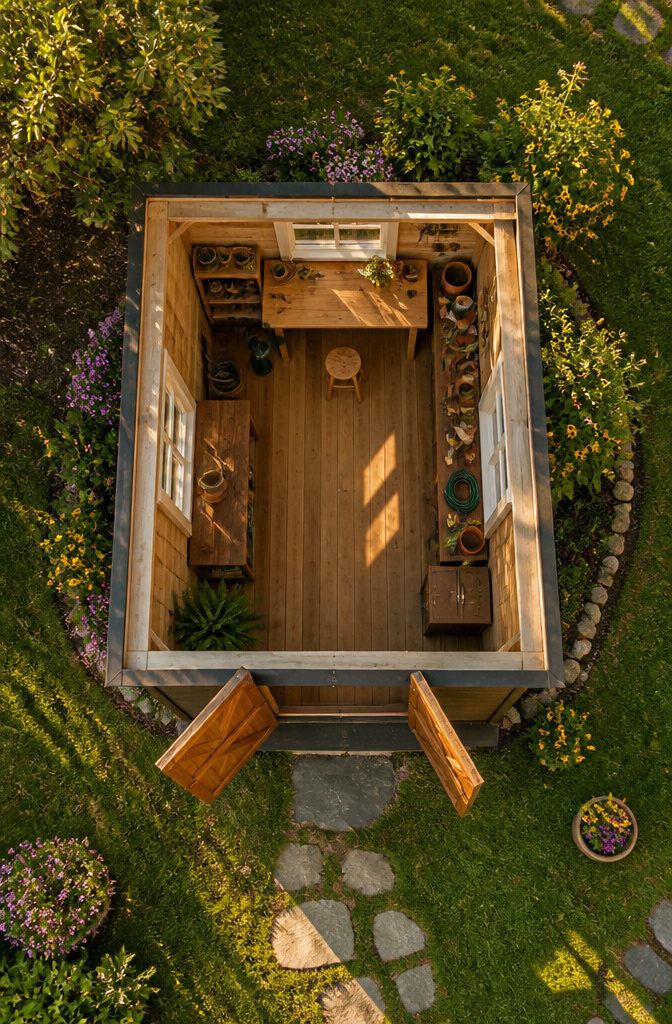
The $3,943 price tag on the ShedMaster Meadowview tells you where the money goes, and where it doesn’t. Wall and roof components, doors with hardware, and floorboards on select models come in the box.
The roof itself does not; shingles, tin, or PVC are a separate trip to the store. Foundation materials and anchors are on you too, and if you’ve got leftover roofing from a house project, that is where the savings start.
Three large windows and a big barn door plus a side door give the Meadowview its airy feel. "Spacious interior" is what the listing promises, with no exact square footage attached, so measure your footprint before you cut the check.
The wood arrives pre-cut and doors come pre-hung, which is how a first-timer with basic tools finishes in a weekend.
But the lower cost shows in the grade of lumber and the hardware thickness. After a few humid summers, the door swing and the window seal are where you notice you bought a kit, not a cabin.
Still, for a potting bench, a bike shop, or a writing corner, the space and light are the point, and those it delivers.

Compact 3x5 FT Design – Ideal for small outdoor spaces such as patios, balconies, and narrow side yards. Great for organizing tools and supplies.

[ Secure and Durable Storage Shed ] Our outdoor storage shed take durable steel frame structure, the overall electroplating steel process and paint treatment to make outdoor shed rust moisture-proof and anti-corrosion, in a variety of climates can be used without worry.

[Outdoor Storage Shed]: This 3x3FT metal storage shed is designed to optimise your outdoor space. It is perfectly suited to storing lawn mowers, gardening tools and outdoor furniture. The design is sleek and modern, blending seamlessly into any garden, backyard or patio, and is both aesthetically pleasing and functional.
9. Backyard Discovery Cedar Wood Greenhouse

A greenhouse kit for a hobby shed only works if you actually need greenhouse glass, and for most hands-on hobbies that glass turns into a liability fast.
The Backyard Discovery Cedar Wood Greenhouse runs $2,799 for 50 square feet, which puts it at the premium end of the kits in this list.
That footprint includes a workstation with shelving and a storage rack, plus electrical outlets and USB ports once you run power. For a gardener starting seedlings or keeping tropicals alive through a Northeast winter, the enclosed glazing makes sense.
But if your hobby is woodworking, pottery, or anything that kicks up dust and shavings, all that glass traps heat and shows every smudge while offering no wall space for a real tool board.
I would treat this as shed-like only in two directions. Leave the glazing open to a covered porch feel and use it as a bright reading room, which the manufacturer suggests.
Or treat it as a dedicated plant room and build your messier workshop in something with solid cedar siding you can seal up.
The small footprint already limits work surface; divide it between potting soil and a bandsaw and you will fight the space every single weekend.
The trellis option softens the garden look and might help with vines for privacy, though that does nothing for interior function. Budget another few hundred for the electrical connection, which the kit assumes you will arrange separately.

Wide Applications: This t-handle lock with spring gate latch kit perfect for sheds, barns, chicken coops, playhouses, campers, and toolboxes. Ensures doors stay latched even in 50mph winds.

Secure and Stable:Shed door hardware kit is equipped with 6" T-Hinges, Heavy Duty Barrel Bolts, and T-Handle Locks for maximum security and stability shed lock kinged shed door handle shed door latch
10. VESTAEL Modular Pod

The VESTAEL Modular Pod ships as 118 square feet of insulated, pre-wired space for $15,000. That insulation is what separates it from most backyard hobby shed kits left sitting in a hardware store parking lot.
Four-season use only works if the walls do more than block wind, and here they actually hold temperature well enough that a space heater in January or a small AC unit in July keeps the interior usable.
Modular construction means the pod arrives in finished sections, not a pallet of dimensional lumber and a bag of screws. The wiring and insulation are factory-installed, so the weekend timeline becomes delivery-plus-connection rather than build-from-stud-up.
Whether the price gap to a basic wood kit is recoverable depends on how many seasons you need. A $3,000 uninsulated kit sits empty from December through March and cooks you from June through August.
Spend another $2,000 on after-market insulation and electrical and you’re still doing the work yourself. The VESTAEL premium buys back those weekends and the months in between.
OEKOTEX Certified and No Shedding Medium Pile( 0.50 inch - 0.60 inch ) Runner Rug. Proudly Custom Size By Feet in USA Facility
Made In Turkey, Finished In USA | Slip Resistant Rubber Back | Colorfast | Stain Resistant | Custom Size For Your Need | Both Ends Are Finished

OEKOTEX Certified and No Shedding Medium Pile( 0.50 inch - 0.60 inch ) Runner Rug. Proudly Custom Size By Feet in USA Facility
11. Best Barns Inc. Belmont

Barn styling usually tacks on a few dollars for looks, but in the Best Barns Inc. Belmont the extra $2,288 over similar-sized competitors buys something structural.
The gambrel roof raises the center wall height enough to give you a full second-floor loft, not the crawl-space storage you get when a shed maker calls something a loft but means you can slide Rubbermaid bins under a slope.
Here you could stand at the ridge, or at least sit in a chair near it, which matters if your hobby involves anything more vertical than sorting seed packets.
The cottage details, shutters, dormer window and vintage-style lantern, read charming on the listing page. In person they are unfinished wood meant for paint.
Budget a weekend for that, plus another for assembly. The kit ships as pre-cut panels, but the trim and hardware demand patience.
Two people are necessary once the walls are up and you are ready to hang the door; the hinges alone are fiddly enough that working solo turns a three-day project into a five-day frustration.
At $9,486 this is not the shed you buy to store a mower.
The premium lands on headroom and aesthetics together, which only pays off if you plan to work inside it regularly or simply want the backyard view to look like a miniature house rather than a box with a roof.
12. TECHNOFLEX Solid Wood
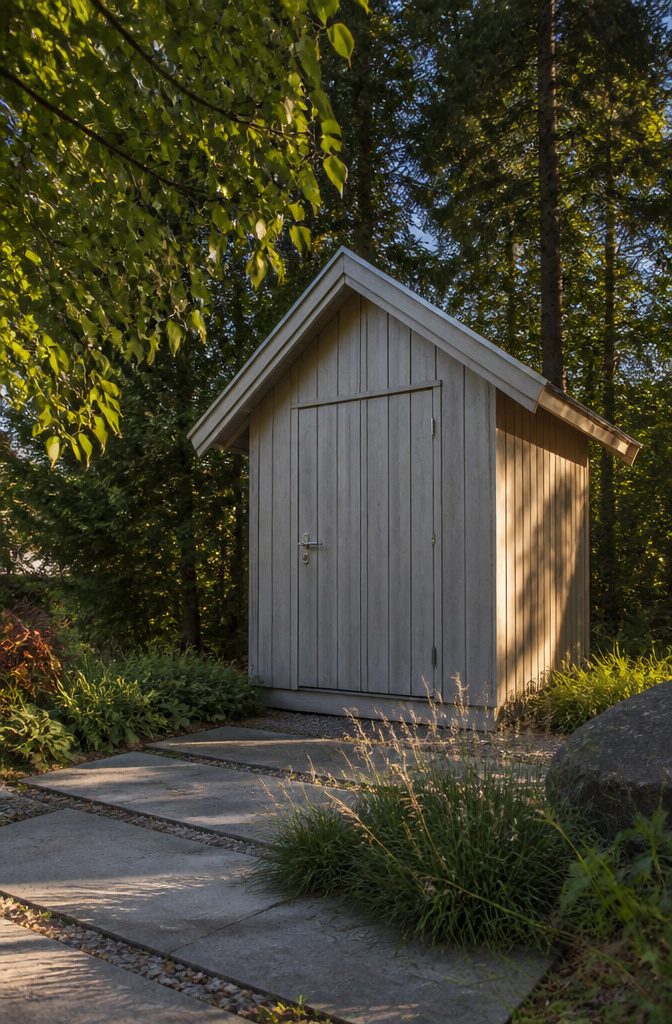
At $7,529 the TECHNOFLEX sits at a price that demands you know what you’re paying for. Nordic wood in this context means solid Norway spruce, a tighter-grained cousin of the white pine you find at box stores.
It weathers to a silver-gray naturally, though the untreated boards will darken unevenly where rain drips and sun hits, so the claim that it needs no treatment holds technically and fails aesthetically unless you like the barn-wood look fast.
The double tongue-and-groove joinery is where the cost argument lives.
Standard cedar shed kits ship with single-notch boards that shrink and rattle after two seasons of freeze-thaw. Two interlocking grooves leaves less room for air intrusion and the warping that follows.
Whether that justifies roughly double the price of a cedar kit the same footprint depends on your climate; in the Southwest the gap is harder to defend, in the Northeast the tighter wall pays back faster than a Space Heater Saturday patch job.
What the price does not buy you: foundation, roof shingles, or stain. Those three line items ran me another $340 on my last build, which puts real walk-in cost closer to $7,870 before you’ve hung a single tool.
13. Outdoor Living Today Cedar Sunshed

The Outdoor Living Today Cedar Sunshed runs $7,098, and those eight screened windows are what you’re paying for against its competitors.
In a workshop shedding sawdust from a router table or sander, fine dust collects on mesh the same way it coats every flat surface.
The aluminum screen frames are lockable, which matters more for the greenhouse use the kit suggests, but dust infiltration is the real durability question for a hobbyist.
Polygal roof panels diffuse the overhead light so you are not working in eight separate spotlights, though the overall lumen level stays softer than the Astoria’s single full-glass wall, where one clean bank of light hits your bench from one direction only.
I would want supplemental task lighting for detail work in either, but the Sunshed’s wraparound windows mean fewer shadowed corners when the sun is high.
The included L-shaped workbench and shelving save a weekend of custom carpentry, which helps justify the price gap against a bare shell.
For a potter or painter working clean materials, the screens and cross-ventilation are genuinely useful. For a woodworker, the dust question pushes this toward occasional-use status unless you add an air filter you rig yourself.
14. Handy Home Products DIY Wooden

Seven-foot sidewalls sound generous until you are standing at a workbench trying to use a grinder.
The Handy Home Products DIY wooden kit runs $3,499 at list, occasionally discounted to the $3,200 range, and those sidewalls give you enough overhead to stay upright but not enough to feel open.
For a storage-first shed, the wall height hides a compromise: the pre-cut studs and pre-hung doors speed assembly for a first-time builder with basic tools, yet the interior volume is still optimized for stacked bins rather than standing project space.
I would want to test the floor kit before committing any bench to a permanent spot. The kit includes a floor, which is not a given in this price bracket, but the footprint stays storage-minded.
Add a bench along one wall and you lose the aisle width meant for lawn equipment. The operable windows help, yet they sit where storage sheds put them, not where a hand tool user needs light.
The corners cut are in the framing grade and the door hardware. Handy Home has sold through Home Depot for decades, so the support network is there, but the wood itself is kit-grade, not furniture-grade.
For a few hundred dollars in lumber and a weekend, you can reinforce the bench wall and upgrade the hinges.
Without that extra work, this shed stays a storage box that tolerates occasional hobby use, not a workshop that happens to store things.
15. Modern Shed Custom

A custom Modern Shed starts with a conversation, not a checkout cart. You pick the dimensions, window placement, siding, and interior finishes, and a specialist builds the design around how you’ll actually use the space.
That part is genuinely useful if you need something specific, say a 10×10 footprint with two people working out inside, which a kit rarely accommodates without cutting and hoping.
The difference from modifying a kit on site is where the work happens. Customization occurs in the factory: engineered panels, pre-finished surfaces, and windows cut to order.
A kit demands your saw and your weekends to alter after delivery, and owners on Reddit mention that the "assembled in 1–2 days" promise often hides the real labor of foundations, electric, and climate control still ahead.
Modern Shed’s turnkey delivery skips that construction zone, though you will need site prep and utility connections handled separately.
Where the budget lands is the gap the company leaves deliberately open.
No fixed price appears on their site because every variable moves the number. In practice, similar prefab structures with high-end finishes and turnkey delivery from competitors in this segment run from roughly $47,500 to well past $100,000 depending on size and options.
For a backyard hobby shed, that places the custom route at the top of the comparison, worth it if the exact footprint and finish matter more than the cash.
What the Kit Includes

The pallet that shows up holds wall and roof boards cut to size, plus a manual and blueprint inside.
Most kits also include dual-pane glass doors and windows with hardware, floorboards on select models, trim, and a few spare boards for mistakes. The double tongue-and-groove wall system fits together piece by piece.
What you will not find on that pallet are the things that vary too much by climate and taste: the foundation, the top layer of roofing, and any stain or finish.
Foundation materials sit entirely outside the kit, though the range of acceptable bases is wide. A concrete slab or compressed gravel bed works almost anywhere.
In warmer, drier zones with firm ground, patio stones, cinder blocks, or even super spikes under treated floor joists can suffice. Soft soil pushes you toward a treated wood grid on concrete piers.
Anchors, if your foundation type needs them, are another separate trip to the store. For the roof itself, leftover shingles or tin from a house project often fits the bill.
Assembly Time and Tools
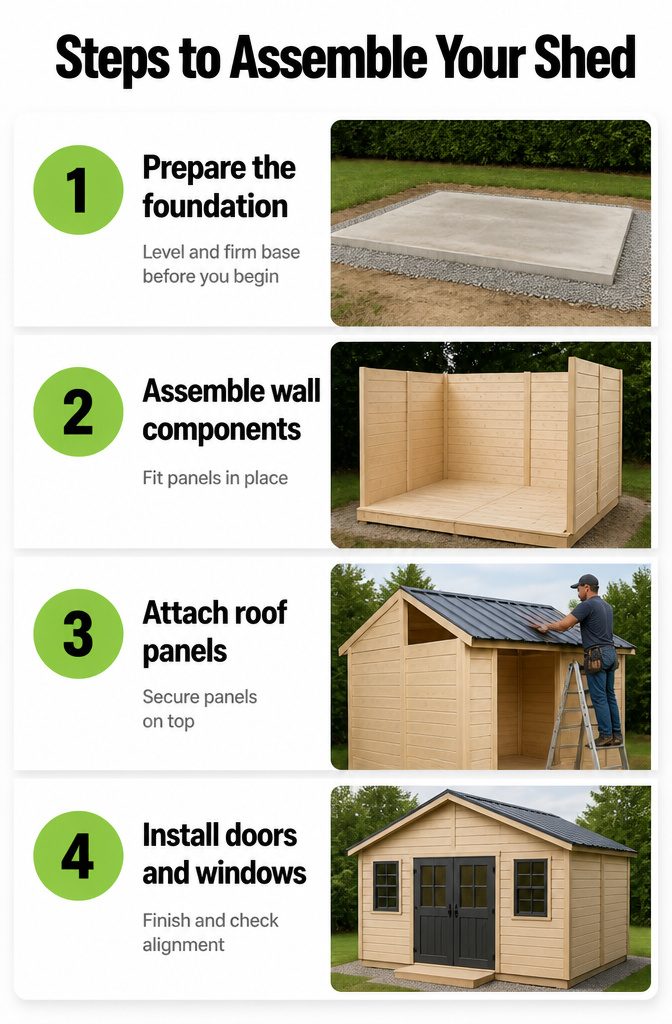
A SolidBuild shed goes together in 8–12 hours with two people and a handful of common tools: hammer, mallet, screwdriver. The wall and roof components fit in a tongue-and-groove style, so the work is more repetitive carpentry than advanced joinery.
Going solo is realistic if you’re steady on a ladder and patient with the roof panels.
The company notes that customers often tackle the assembly alone and only bring in a contractor for the foundation work. One customer finished hers while her husband was at work, so a single capable person can manage the build.
What stretches that 8–12 hour estimate is almost always the base, not the walls.
A concrete slab or compressed gravel pad needs to be level and firm before the first wall goes up, and that prep sits outside the kit time entirely.
The same applies to treated wood grid foundations or any pier setup for soft soil.
Treated floor joists can sit on patio stones, super spikes, or cinder blocks in warmer, drier climates, but those options still demand a level starting surface.
Unclear instructions tend to surface when the foundation type varies from the manual’s default example.
Spending an extra hour confirming which anchor suits your base saves the half-day of backtracking that vague guidance invites. The video library helps here; use it before you unbox the boards.
Wood Types and Material Quality

Cedar boards in a shed kit weather to silver-gray whether you want them to or not, so the real question is whether you pay now for factory-treated stock or handle the maintenance yourself later.
I have watched untreated Norway spruce walls darken unevenly where the drip line hits, and the contrast never quite evens out. The SolidBuild kits ship that way on purpose: sustainably harvested, double tongue-and-groove, and completely raw.
You are meant to choose your own stain once the pallet arrives, which keeps the upfront cost lower but adds a weekend of brushing and a re-coat every two to three years in wet climates.
Eco-friendly claims are harder to weigh.
SolidBuild notes its spruce is sustainably harvested, though no certification is named on the page. The Outdoor Living Today Cedar Wood Sunshed leans into the same appeal with its natural cedar and Polygal roof panels for light.
For a hobby shed you will actually work inside, the roof panel matters more than the wall wood, because cedar without a UV-stable finish still checks and splits.
Untreated wood demands a schedule: stain the first year, inspect the second, or the third year brings gray fuzz and raised grain that no longer holds coating well.
If you need the shed functional fast, raw wood is the wrong economy. Budget for stain plus a dry forty-eight hours before you move anything inside, or the smell lingers and the finish traps fingerprints.
Insulation and Electricity

Most shed walls are built to breathe, so traditional post-and-beam framing with drywall will fight the wood as it expands and contracts, opening gaps and splits over time.
The workable path runs through the roof and floor instead. For the floor, a sub-floor goes down first, then the joist cavities get stuffed with insulation material of your choice.
For the roof, a 2×2 grid on top of the existing boards holds the same fill, covered by plywood or additional boards before the final roofing goes on.
Electrical setup is doable but needs forethought.
Running an extension cable from the house and routing it beneath the shed floor is the simplest route; if local codes allow, a dedicated junction box with conduit runs inside or outside to outlet locations works too.
The permit line matters here, since some towns exempt sheds below a certain square footage until you wire them, at which point the threshold no longer protects you.
Four-season use splits on climate. A space heater keeps the shed comfortable down to the 40s if the roof and floor are insulated, which covers the Pacific Northwest or Southeast through a full year.
Deep-winter regions get three-season utility instead, with January and February pushing back to the house.
Frequently Asked Questions
What is included in a backyard hobby shed kit?
Most kits ship with wall and roof components, doors with hardware, and sometimes windows or floorboards, but you are almost always on your own for foundation materials, anchors, and roofing.
The ShedMaster Meadowview, for example, excludes shingles, tin, or PVC entirely. The VESTAEL Modular Pod is the exception: it arrives pre-wired and insulated, factory-finished, with no weekend assembly of studs or screws.
Is it difficult to assemble a backyard hobby shed by yourself?
A first-timer with basic tools can finish many kits in a weekend if the wood is pre-cut and doors come pre-hung.
Two people become necessary once wall panels are standing and doors need hanging; solo builders on Reddit report that promised timelines often ignore the real labor of foundations, electric, and climate control still ahead.
Factory-built options like the VESTAEL skip the construction zone entirely.
Can a wooden backyard hobby shed be insulated?
Traditional wall insulation with post-and-beam framing and drywall will not work on kit sheds because it prevents the wall boards from expanding and contracting, which causes gaps and splits.
You can insulate the roof and floor by stuffing insulation between joists or forming a grid above the roof boards, then covering with plywood before roofing.
The VESTAEL Modular Pod ships with factory-installed insulation and wiring, which is why it costs roughly triple a basic wood kit.